 Reviews


 Proudly American


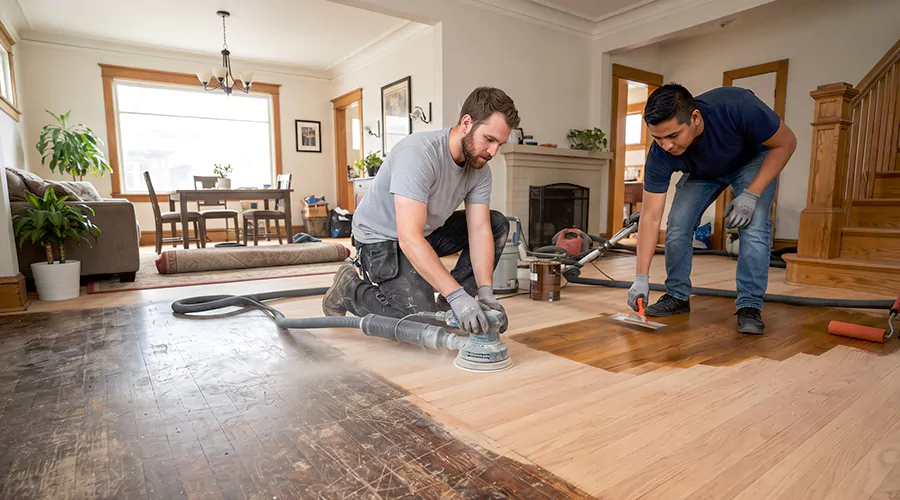
Hardwood floors should usually be refinished instead of replaced when the boards remain structurally sound, with professional hardwood floor refinishing costing about $3 to $8 per square foot in 2026. Water damage floor repair becomes more practical when moisture has caused severe structural damage or no usable wear layer remains.
Refinishing works well for worn finishes or deep scratches. It can also restore faded flooring without removing the original boards.
When Is Refinishing the Better Choice?
Refinishing is usually the better option when the damage affects the finish or upper surface rather than the structure of the boards. The National Wood Flooring Association recommends full sanding and refinishing when deep scratches are present or when the finish has worn away enough to expose bare wood.
Refinishing is a good option when:
- Boards remain flat and stable.
- The finish looks dull or faded.
- Scratches affect the surface.
- Bare wood appears in traffic areas.
- You want to change the stain color.
- A few damaged boards can be repaired separately.
Wood floor refinishing preserves the existing material while renewing its appearance. An old-looking floor does not automatically need replacement.
When is Hardwood Floor Replacement Better?
Replacement makes more sense when damage extends through the boards or affects the structure beneath them. Sanding removes a small amount of wood from the surface. It cannot correct widespread rot or serious subfloor failure.
Replacement becomes more likely when:
- Large sections are badly buckled.
- Boards feel soft from decay.
- The subfloor has significant damage.
- Tongues or grooves are exposed.
- Previous sanding left little usable wood.
- Water damage affects many boards.
- Large areas contain split or loose flooring.
- The floor has widespread structural movement.
A few damaged boards do not always justify replacing an entire room. Local repairs can sometimes be completed before hardwood floor restoration begins.
How Do Refinishing and Replacement Costs Compare?
Refinishing usually costs less when the existing wood can remain. Current 2026 pricing places hardwood floor refinishing at about $3 to $8 per square foot. Many complete projects cost roughly $1,100 to $2,700 before extensive board repairs.
| Floor Condition | Likely Approach | Cost Effect |
|---|---|---|
| Dull finish | Recoat | Lowest |
| Deep surface scratches | Refinish | Moderate |
| Several damaged boards | Repair then refinish | Higher |
| Widespread warping | Partial replacement | High |
| Structural failure | Full replacement | Highest |
The cost to refinish hardwood floors can increase when damaged boards need repair first. Keeping most of the existing flooring can still avoid the material cost associated with complete replacement.
Can Old Hardwood Floors Still Be Refinished?
Old hardwood can often be refinished when enough usable wood remains above the tongue. Age by itself does not determine whether replacement is necessary. The floor's thickness and previous sanding history matter much more.
Refinishing old hardwood floors can make sense even when the flooring is decades old.
The NWFA notes that the number of times a floor can be sanded depends on factors such as wear-layer thickness and previous sanding. Floor condition also affects the decision.
Can Engineered Hardwood Be Refinished?
Engineered hardwood can sometimes be refinished when its real-wood wear layer is thick enough. Unlike solid hardwood, engineered flooring has a wood veneer over a layered core. Removing too much material can expose that core.
Before trying to refinish engineered hardwood, check:
- Wear-layer thickness
- Previous sanding history
- Manufacturer guidance
- Depth of the damage
Refinishing engineered wood floors becomes less practical when the veneer is already thin.
Can Water-Damaged Hardwood Be Refinished?
Water-damaged hardwood can sometimes be refinished after moisture levels return to normal. Mild cupping may improve during proper drying. Buckling or decay can indicate damage that sanding will not correct.
Do not restore water damaged wood floor areas by sanding them while the boards are still wet.
Sanding a cupped floor too early can create an uneven surface once the wood finishes drying. Subfloor moisture should also be resolved before cosmetic work begins.
How Can You Tell if Your Floor Can Be Refinished?
A basic condition check can help separate surface wear from structural damage. Examine several parts of the room rather than making a decision based on one badly damaged board.
Check for these signs:
- Boards move when stepped on.
- Several boards contain deep splits.
- Nail heads are becoming exposed.
- Board edges remain raised after drying.
- Stained areas feel soft.
- Bare wood shows through worn finish.
- Large areas feel uneven.
- Boards remain stable despite surface scratches.
Surface wear generally supports refinishing. Movement or decay points toward a deeper repair problem.
When Should You Call a Professional?
Professional assessment is appropriate when the remaining wear layer is unclear or the floor has already been sanded several times. Water damage also deserves closer evaluation because moisture beneath the boards can affect the final result.
Consider professional assessment when:
- Tongues or nail heads are visible.
- The floor has undergone several refinishing cycles.
- Boards remain badly cupped.
- Water reached the subfloor.
- Engineered flooring has an unknown wear layer.
- Many boards require repair.
Sanding and refinishing hardwood floors removes real wood from the surface. Excessive sanding can damage a floor that might otherwise have remained usable.
How Can You Delay Hardwood Floor Replacement?
Regular maintenance can protect the finish and reduce the need for frequent full sanding. The NWFA recommends routine sweeping or vacuuming. Spills should also be wiped up quickly because repeated moisture can damage the finish and wood.
Helpful maintenance habits include:
- Vacuum or dust-mop regularly.
- Wipe spills up immediately.
- Use a finish-compatible cleaner.
- Put protective pads under furniture.
- Maintain indoor humidity near 30 to 50 percent.
- Recoat the finish before bare wood appears.
A maintenance coat can refresh a dull floor without removing as much material as hardwood floor resurfacing.
Conclusion
Hardwood floors should usually be refinished instead of replaced when the boards remain solid and most damage is near the surface. Replacement becomes more practical when widespread rot or serious warping affects the floor. Subfloor failure is another strong reason to replace damaged sections. Since refinishing usually costs less, check the remaining wear layer and structural condition before removing an otherwise usable hardwood floor.
Frequently Asked Questions
Can deeply scratched hardwood floors be refinished?
Yes, in many cases. Deep scratches can often be sanded away when enough usable wood remains.
Is refinishing worth it for very old hardwood?
Often, yes. Age matters less than the floor's structural condition and remaining thickness.
How many times can hardwood floors be refinished?
There is no fixed number. The answer depends on the wear layer and previous sanding history.
Should I replace hardwood if only a few boards are damaged?
Usually not. Individual damaged boards can often be repaired before the surrounding floor is refinished.
Can faded hardwood floors be refinished?
Yes. Fading is often a cosmetic issue that can be corrected during sanding and finishing.
Can a dull hardwood floor be restored without full sanding?
Sometimes. A maintenance coat may be enough when the existing finish is worn but the wood beneath it remains undamaged.